
A publication from
Visit Beebolt

The 54 chokepoints that hold up the high-tech value chain.

The first independent, quarterly ranking of the supply nodes the semiconductor industry cannot afford to lose. Scored on Fragility, Importance, and Interdependence.
Report №1 goes live in
--
Days
--
Hours
--
Min
--
Sec
The 54 · Critical band
01EUV Lithography9.4
02ABF Substrate9.2
03Spruce Pine Quartz9.0
04Photoresists8.8
05Neon Gas8.6
Part I · The list
01
Critical chokepoints, ranked by fragility, importance, and interdependence.
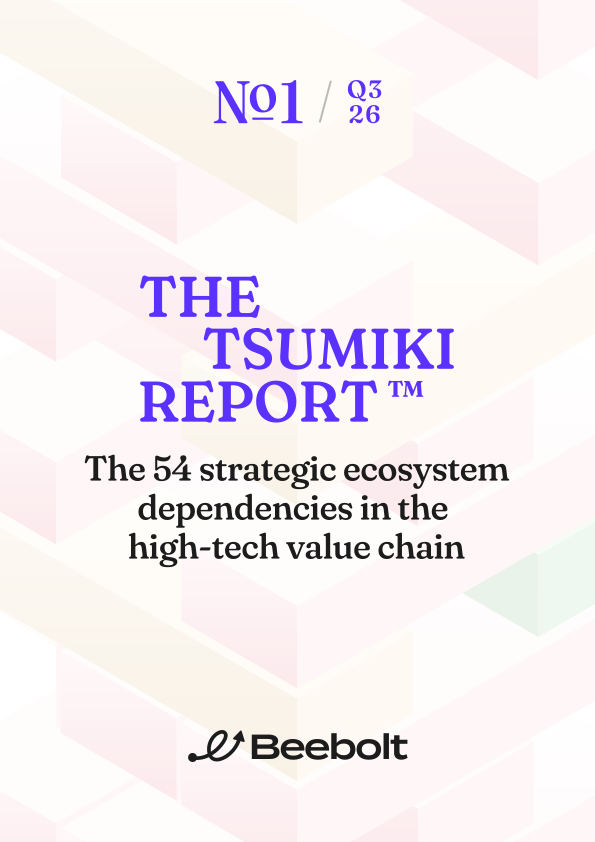
The Tsumiki Report №1 — The 54 Chokepoints (cover)
Search the 54

Is your supply chain on the list?

Type a company, material, or node — TSMC, ABF, Hormuz, Spruce Pine quartz. We'll tell you where it ranks among the 54.

54 chokepoints · 18 layers · Full details inside the report

Why this report

A map of what we quietly depend on.

The high-tech supply chain is a tower of small, specific pieces — each one easy to overlook, each one essential. Pull one. See what falls.

A · The list
54nodes

Chokepoints identified.

Every fragile node in the semiconductor value chain — from EUV lithography to high-purity quartz — scored and ranked by our intelligence team and our research network.

B · The rubric
3axes

Axes of vulnerability.

Each entry is scored on Fragility, Importance, and Interdependence. Same evidence-based discipline Moody's uses to rate bonds — anchored to documented examples.

C · The signal
4bands

Bands you can act on.

Critical you plan around. High you build playbooks for. Medium you monitor. Low is already mitigated.

From the issue

The people shaping this conversation.

Most readers will not have heard of ABF substrate, EUV pellicles, or Spruce Pine quartz before opening this issue. By the end of it, they will understand why all three matter, who controls them, and what happens if one breaks.

The supply chain everyone talks about runs on materials made by a country no one talks about. The Tsumiki Report is the first to put names, numbers, and trend lines on what the rest of us only intuit.

We've long needed an independent, evidence-based ranking of where the real fragility sits. №1 lands with the kind of rigor the industry has been asking for — and the kind we plan to operate against.

Methodology · v1.4

How we rank the 54.

A short, public methodology. The full internal rubric is held by the Beebolt intelligence team. Two analysts following it should land within one point on any axis.

Bands & reader action
Plan around it.
No mitigation at scale. You cannot mitigate, you plan around them.
Watch and playbook.
2–24 month diversification horizon. Build contingency now.
Monitor.
Standard diversification works. Keep in normal review cycle.
Already mitigated.
Distributed, fungible. Commoditization has reduced the risk.
The 3 axes  ·  how scores are motivated
Fragility
How concentrated is the supply? Single-source risk at the level of supplier, site, geography, and political jurisdiction.
Importance
How bad is the impact if it fails? Depth of damage to the primary industry that uses the chokepoint.
Interdependence
How many industries does it touch? Breadth of cross-industry exposure, direct and first-order indirect.

Not arbitrary, not pure formula. Each entry is scored against documented anchor examples held in the internal rubric, with 2–3 sentences of evidence per axis. Closest analogy: Moody's credit ratings.

The trend signal
Rising
Adverse event this quarter. Fragility moving up.
Stable
No material change. Most common.
Easing
Positive event; may be temporary.
Inaugural issue · Limited release

Reserve your copy of №1.

Register now and receive the full Tsumiki Report the moment it launches — 54 chokepoints, top 10 deep-dives, the trend signals, methodology, and the source manifest.

Your data stays with Beebolt — we don't share or sell it. You'll be among the first to receive the report when №1 goes live.